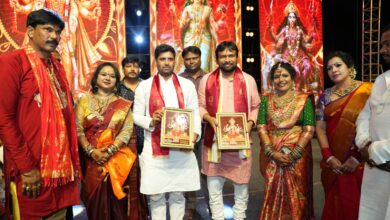
Mahashtami: When the Goddess Confronts the Darkness Within.

Dr Srabani Basu, Associate Professor, Department of Literature and Languages, SRM University AP
Maha Ashtami is not merely the eighth day of Durga Puja. It is an encounter with the paradoxes of feminine divinity: tenderness and ferocity, innocence and sovereignty, preservation and destruction. The Goddess who receives flowers from folded hands is also the warrior who annihilates forces threatening cosmic order. The child worshipped during Kumari Puja and the terrifying Chamunda invoked at Sandhi Puja inhabit the same sacred imagination. Together they invite a question that reaches beyond religion: why do we celebrate the power of the Goddess while so often fearing it in living women?


Ashtami falls on the eighth tithi of the waxing lunar fortnight of Ashwin. A tithi is calculated from the changing angular relationship between sun and moon rather than from the conventional midnight-to-midnight day. This distinction matters profoundly for Sandhi Puja, observed at the transition between Ashtami and Navami. Alongside Pushpanjali and, in certain traditions, Kumari Puja, it makes Ashtami one of the most emotionally charged occasions of Bengali Durga Puja. Its significance, however, cannot be exhausted by the familiar formula of good triumphing over evil. The rituals also interrogate the nature of power, the fragility of human identity and the possibility of transformation.
A principal theological foundation lies in the Devi Mahatmya, also known as the Chandi or Durga Saptashati, incorporated into the Markandeya Purana. Generally dated to approximately the fifth or sixth century CE, it helped consolidate the understanding of the Goddess as supreme divine power. Thomas B. Coburn, in Devi-Mahatmya: The Crystallization of the Goddess Tradition (1984), examines this decisive development. Here the Goddess is not simply protected by male divinities or dependent upon their authority. She restores cosmic order when other divine powers fail. Her strength is intrinsic, not a reward for obedience.
Yet this protector of existence assumes terrifying forms. In the seventh chapter of the Devi Mahatmya, the demons Chanda and Munda confront the Goddess. From the forehead of the enraged Ambika emerges the dark, fearsome Kali, who defeats the demonic forces, kills Chanda and Munda and presents their heads to Chandika. She is consequently named Chamunda. The episode refuses to separate nurturing femininity from formidable resistance. Destruction, within the mythic framework, serves the restoration of threatened order. Importantly, although Chamunda’s victory provides the narrative foundation for Sandhi Puja, the precise association with the Ashtami–Navami junction belongs to later ritual tradition, not an explicit calendrical statement in that episode.
Chamunda challenges an enduring social expectation: that femininity must remain gentle to be acceptable. Her anger is neither an embarrassment nor a failure of composure. It is directed against destructive power. This is not a licence for cruelty, nor should mythological warfare be translated into violence against human opponents. But the distinction between anger used to dominate and anger arising from resistance to injustice is ethically indispensable. Why do societies applaud women’s nurturing capacities yet become uncomfortable when women refuse submission? Chamunda exposes the poverty of an ideal that honours feminine power only when it is agreeable.
The most intense ritual expression of this mythology occurs during Sandhi Puja. Sandhi means junction: the worship occupies the last twenty-four minutes of Ashtami and the first twenty-four minutes of Navami, a forty-eight-minute sacred interval. Durga is invoked in her Chamunda manifestation. Because the tithi follows lunar calculation, the ceremony may occur during daylight or deep into the night. Sacred time does not bend to human convenience; the worshipper must recognise the threshold as it arrives.
That threshold carries philosophical significance. Human beings often imagine transformation as a gradual movement between stable states, yet some of life’s defining experiences occur when an old identity has dissolved and a new one has not fully emerged. Anthropologist Victor Turner’s The Ritual Process: Structure and Anti-Structure (1969), building upon Arnold van Gennep’s work on rites of passage, offers the concept of liminality as a useful interpretive lens. Sandhi Puja is not identical to the rites Turner studied, but its consecration of an interval between two temporal categories invites comparison. Between certainty and doubt, attachment and separation, grief and acceptance, we too inhabit thresholds that cannot be comfortably named.
Traditionally, 108 lotus flowers and 108 lamps are offered during Sandhi Puja, though arrangements vary. The number 108 recurs throughout Hindu ritual practice, without possessing one universally accepted symbolic explanation. The lotus, flourishing in muddy water, evokes the possibility of purity and beauty within imperfect conditions. The lamps suggest illumination and the overcoming of ignorance. Their combined effect is more than numerical symbolism: flames flicker before the Goddess, conch shells sound, and the dhak gathers urgency. Public celebration yields, momentarily, to concentrated devotional attention. The spectacle reminds us that light becomes meaningful precisely because darkness exists.
Sandhi Puja also brings us to the difficult history of bali, or sacrifice. Some Shakta traditions have practised animal sacrifice, while others use symbolic offerings such as bananas, pumpkins or gourds. These practices emerged from complex relationships among divine power, ritual obligation, protection and regional custom; their history cannot be reduced to one moral explanation. Belur Math offers a particularly instructive example. According to its institutional account, when Durga Puja began there in 1901, Swami Vivekananda wished to include animal sacrifice, but Sarada Devi opposed it. Her instruction prevailed, and the Math performs symbolic sacrifice with a banana. The episode shows how a tradition can retain ritual meaning while changing its expression.
Contemporary devotees sometimes understand sacrifice as the surrender of arrogance, jealousy, cruelty, greed and ignorance. This ethical reading should not be confused with the full historical significance of bali, but it raises an unavoidable question: what is achieved by destroying a ritual demon if the impulses associated with destruction remain alive within us? The Goddess’s battlefield cannot be confined to the mythological past. It also becomes a mirror in which human beings encounter their capacity for domination, resentment and indifference.
For many Bengalis, however, Ashtami’s most intimate ritual is Pushpanjali. The word combines pushpa, flower, with anjali, an offering made with joined hands. Devotees bathe, sometimes fast until the ceremony, gather flowers and bel leaves, and repeat mantras under a priest’s guidance. The act appears simple, yet its symbolism is poignant. Before a Goddess adorned with weapons and divine attributes, the worshipper offers something fragile and perishable. The flower will wither, its fragrance disappear. Precisely because it is transient, it becomes an eloquent expression of human vulnerability before a power understood to transcend time.
Pushpanjali also creates a shared emotional space. People of different ages and backgrounds stand together in an act of reverence, although this momentary participation should not be mistaken for proof that religious life has been free of caste, class or gender hierarchies. Nor does every participant necessarily understand the Sanskrit mantras in detail. Ritual meaning travels through rhythm, gesture, repetition, sound, memory and collective presence as well as through linguistic comprehension. The familiar syllables may summon childhood mornings, absent relatives and generations of inherited devotion. In this sense Pushpanjali is not simply prayer; it is also an encounter with remembered belonging.
Perhaps the most provocative Ashtami observance is Kumari Puja, practised in particular Shakta traditions and prominently at Belur Math, though not in every Bengali celebration. A young girl is ceremonially worshipped as a living manifestation of the Divine Mother. Belur Math associates the practice with recognising divine motherhood in the innocence of a child. For the duration of the ceremony, ordinary hierarchies appear reversed: adults, priests and religious authorities offer reverence to someone who ordinarily possesses little institutional power. Her worth does not arise from wealth, education, influence or accomplishment. Divinity is recognised within her very existence.
Yet the ceremony exposes a troubling contradiction. What does it mean to worship a girl as a Goddess while actual girls encounter discrimination, violence, restricted opportunities and curtailed autonomy? Reverence for the symbolic feminine can coexist disturbingly with disregard for living women. More subtly, linking feminine divinity to childhood innocence may reinforce the notion that women deserve honour only when they embody purity, obedience or an approved form of gentleness. That is a contemporary ethical critique, not a claim that the ritual texts themselves formulate modern feminist theory. Nevertheless, it is a question the ritual makes difficult to evade.
If dignity is inherent, it cannot expire when the Kumari grows older, develops independent opinions, challenges authority or chooses a life others dislike. She cannot cease to deserve respect because she is no longer an innocent child. A society that bows before her ceremonially must confront what happens when she begins to speak in her own voice. The true measure of reverence lies beyond the ritual platform, in the freedom and safety granted to girls and women after the flowers have been cleared away.
Placed beside Chamunda, the Kumari becomes even more significant. One figure appears vulnerable and dependent upon adult care; the other is sovereign, fierce and terrifying to her enemies. Yet the same religious imagination accommodates both. The contrast need not be resolved by choosing one image as the authentic feminine ideal. A woman may nurture and resist, grieve and command, love and refuse. Compassion is not submission, and anger is not necessarily moral failure. The Goddess’s multiplicity challenges the narrow categories into which human beings repeatedly attempt to compress female identity.
Ashtami possesses another, distinctly Bengali emotional register. Durga is not only the cosmic warrior; she is Uma, the daughter returning to her parental home for a few precious days. Surrounded by Lakshmi, Saraswati, Ganesha and Kartikeya, she inhabits a domestic world of welcome and affection without surrendering her cosmic sovereignty. The daughter is also the protector; the mother is also the warrior. Bengali devotion holds these identities together without demanding that one diminish the other.
Yet by Ashtami the shadow of Dashami is already visible. The reunion is temporary, and the impending departure intensifies every moment of celebration. Durga Puja becomes a festival not only of devotion but of attachment, memory and anticipated loss. For those whose parents have died or whose ancestral homes have vanished, the homecoming of Uma can awaken an ache that public festivity cannot silence. Uma can return to Menaka. Not every daughter has a mother waiting at the door. The sacred narrative thus becomes inseparable from the deeply human experience of absence.
The ethical significance of Ashtami ultimately rests in how we understand power. The Goddess’s weapons are not simply signs of superiority; within the narrative, they answer a threat to existence. Human history, by contrast, repeatedly demonstrates how power can become an instrument of exploitation and silencing. To read Durga’s battles responsibly is not to label our opponents demons. Such a reading would risk turning sacred mythology into a justification for cruelty. The more demanding task is to recognise arrogance, intolerance, possessiveness and the desire to dominate within ourselves.
Ashtami therefore offers neither an uncomplicated celebration of violence nor a sentimental portrait of motherhood. Its rituals place surrender beside resistance, innocence beside ferocity, impermanence beside enduring power. Pushpanjali asks what we can offer; Kumari Puja asks whom we are willing to honour; Sandhi Puja asks what must change when one condition gives way to another. Together they remind us that transformation is not always gentle, and that true reverence must survive beyond ceremonial gestures.
The flowers will wither. The 108 lamps will go dark. The child worshipped as Kumari will grow into a woman who must negotiate the world’s expectations. But the question will remain: when we bow before the Goddess, are we prepared to honour the same right to dignity, independence and self-determination in the women around us? Perhaps the real battle of Ashtami begins when the rituals end.